Ploutonion at Hierapolis
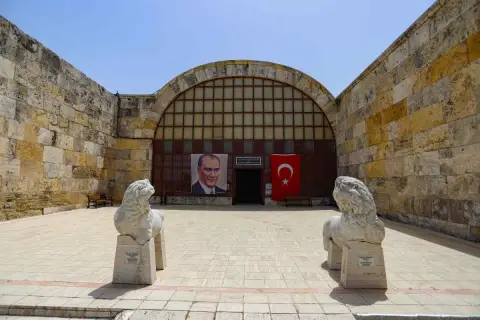
Photos: Seynaeve, CC BY-SA 3.0 · Interfase, CC BY-SA 4.0 — via Wikimedia Commons
Explore the Ploutonion at Hierapolis in Denizli, an ancient sanctuary dedicated to Pluto, known for its toxic gases and mythological significance.
ℹ️ About Ploutonion at Hierapolis
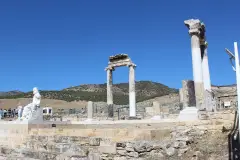
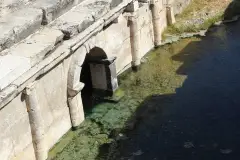
The Ploutonion at Hierapolis, also known as Pluto's Gate, is an ancient religious site dedicated to the god Pluto. Located in the ancient city of Hierapolis near Pamukkale in Denizli Province, Turkey, this sanctuary was revered as the Gateway of Hades. The site was discovered in 1965 by Italian archaeologists and further explored in 2013 by a team led by Francesco D'Andria.
This site is part of “Hierapolis-Pamukkale”, inscribed on the UNESCO World Heritage List (1988).
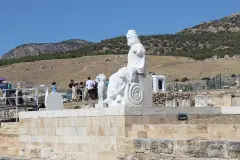
Built on the surface trace of a seismic fault, the Ploutonion was linked to the nearby Apollo's Oracle. A replica of the marble statue of Hades and Cerberus has been restored to its original place, reflecting the site's ancient significance as a ritual passage to the underworld.
History
While the exact age of the Ploutonion is unknown, the nearby city of Hierapolis was founded around 190 BC by King Eumenes II of Pergamum. The site was built atop a cave emitting toxic gases, which were believed to be sent by Pluto, the god of the underworld. Ancient writers such as Strabo, Cassius Dio, and Damascius described the location, noting that animals entering the area met instant death due to suffocating carbon dioxide gas caused by underground geologic activity.
In the early years of the town, castrated priests of Cybele, known as the Galli, descended into the Ploutonion. They crawled over the floor to pockets of oxygen or held their breath to demonstrate immunity to the gas, convincing people that they possessed divine protection. An enclosed area of 2,000 square metres stood in front of the entrance, covered by a thick layer of suffocating gas. Priests sold animals to visitors to test the area's lethality and offered consultations with the oracle of Pluto for a fee.
Archaeological evidence suggests the site was fully functional until the 4th century AD, with sporadic visits continuing for two centuries. The temple was destroyed in the 6th century AD by earthquakes. The entrance was closed off during Christian times.
What to See
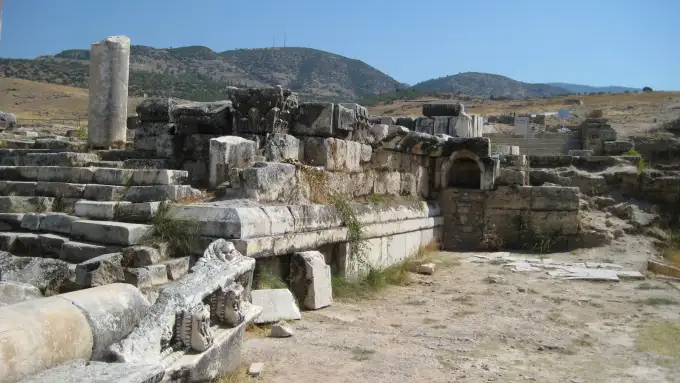
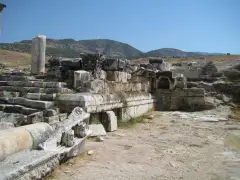
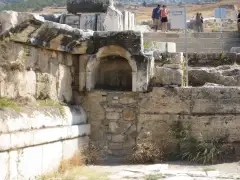
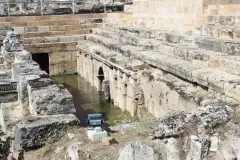
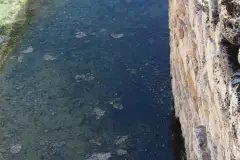
Visitors can observe a small cave, just large enough for one person to enter through a fenced entrance. Inside, stairs lead down to a chamber where suffocating carbon dioxide gas emerges. Behind the 3 square metre roofed chamber lies a deep cleft in the rock, through which fast-flowing hot water passes, releasing a sharp-smelling gas. Archaeologists have noted that the fumes still maintain their deadly properties, as birds attracted by the warm air have been recorded suffocating after breathing the toxic fumes.
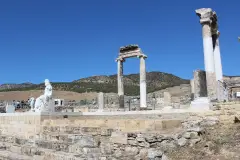
- A replica of the marble statue of Hades and Cerberus, restored to its original place.
- The fenced entrance and stairs leading to the gas-emitting cave.
- The deep cleft in the rock behind the chamber.
Visiting Tips
Wear comfortable shoes for walking on uneven ancient stone surfaces. Since the site is outdoors, bring sun protection such as a hat and sunscreen. Dress modestly, as this is a historical place of worship.
Combine your visit with nearby sights in Hierapolis, such as the Apollo's Oracle, which shares a geological link to this sanctuary. Always follow safety barriers and do not attempt to enter restricted areas due to toxic gases.
Hotels near Ploutonion at Hierapolis
- Colossae Thermal & Spa Hotel ★★★★★ 3.4 km
- Richmond Pamukkale Thermal ★★★★★ 3.6 km
- Lycus River Thermal Hotel ★★★★ 3.3 km
- Hotel Hal - Tur 1.0 km
- Hotel Şahin 1.0 km
- Hotel Hal-Tur 1.0 km
More Museums in Denizli
Ploutonion at Hierapolis – Frequently Asked Questions
What is Ploutonion at Hierapolis?
The Ploutonion at Hierapolis, also known as Pluto's Gate, is an ancient religious site dedicated to the god Pluto. Located in the ancient city of Hierapolis near Pamukkale in Denizli Province, Turkey, this sanctuary was revered as the Gateway of Hades.
Where is Ploutonion at Hierapolis located?
Ploutonion at Hierapolis is in Pamukkale, Denizli, Turkey.
Do children need a ticket at Ploutonion at Hierapolis?
Children aged 0–6 enter Ploutonion at Hierapolis free of charge. Visitors aged 7 and over need a full ticket.
What other museums can I visit in Denizli?
Other museums in Denizli include Denizli Tripolis Archaeological Site, Denizli City Museum and Denizli Atatürk House and Ethnography Museum.